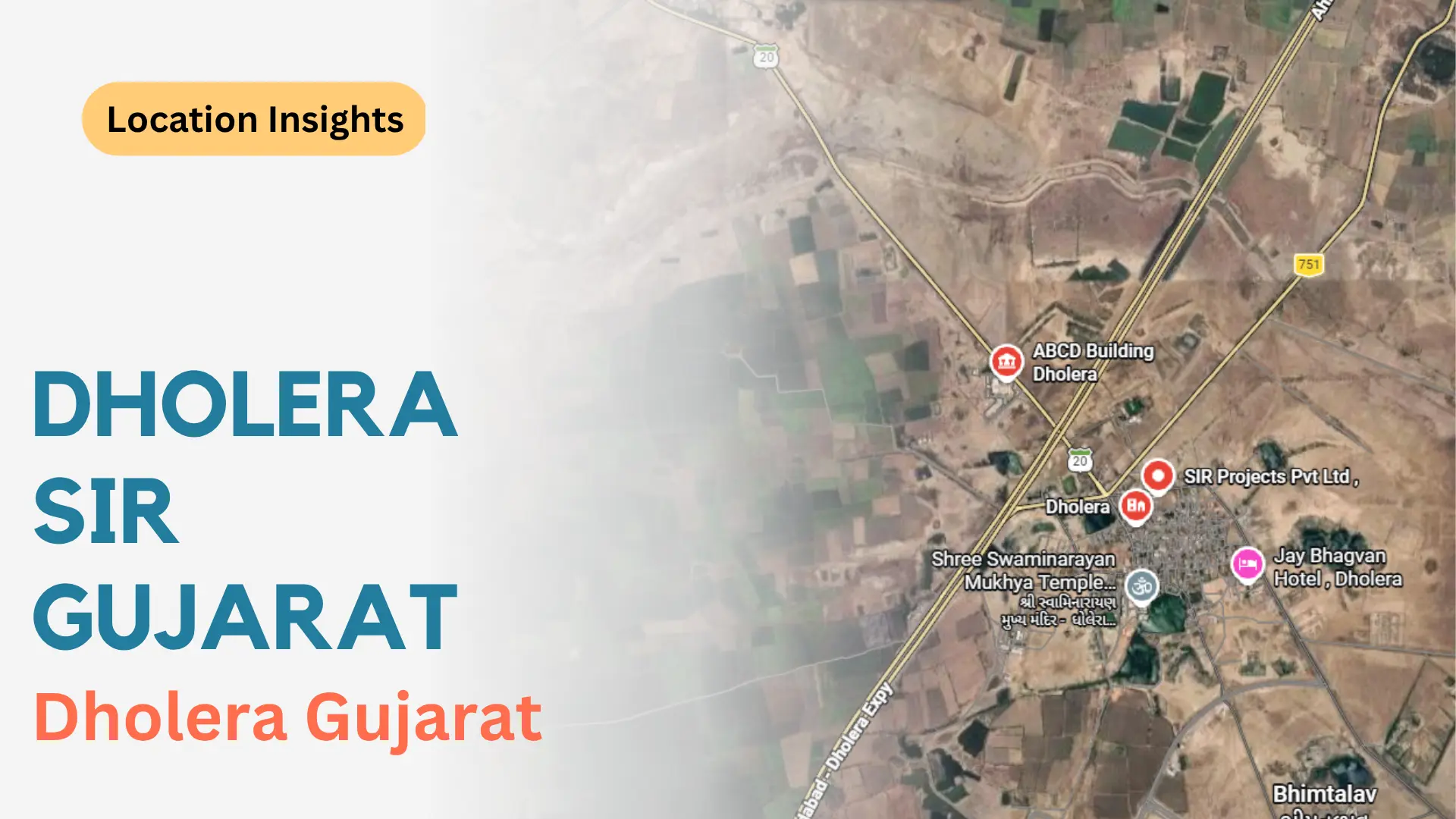
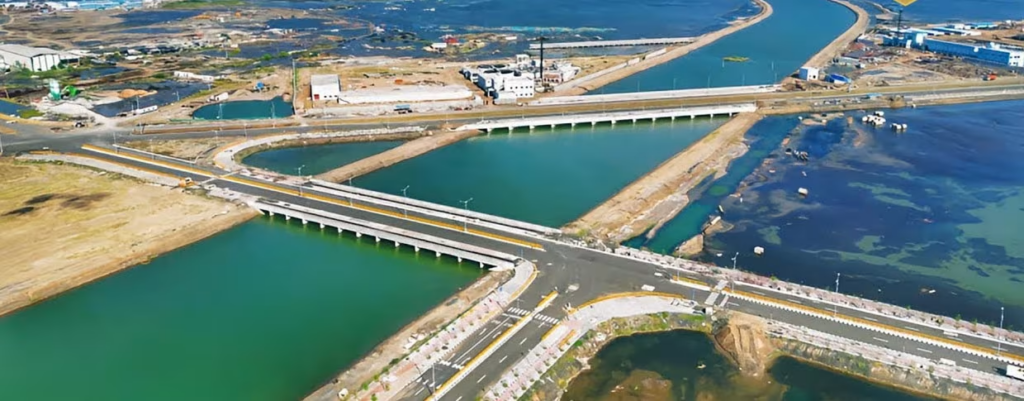
Dholera SIR (Special Investment Region) in Ahmedabad district, Gujarat is India’s first greenfield smart industrial city spanning ~920 km² across 22 villages. Located ~100 km from Ahmedabad, the region is being developed as part of the Delhi-Mumbai Industrial Corridor (DMIC), positioning it as a long-term infrastructure-led real estate investment zone.
Location Context
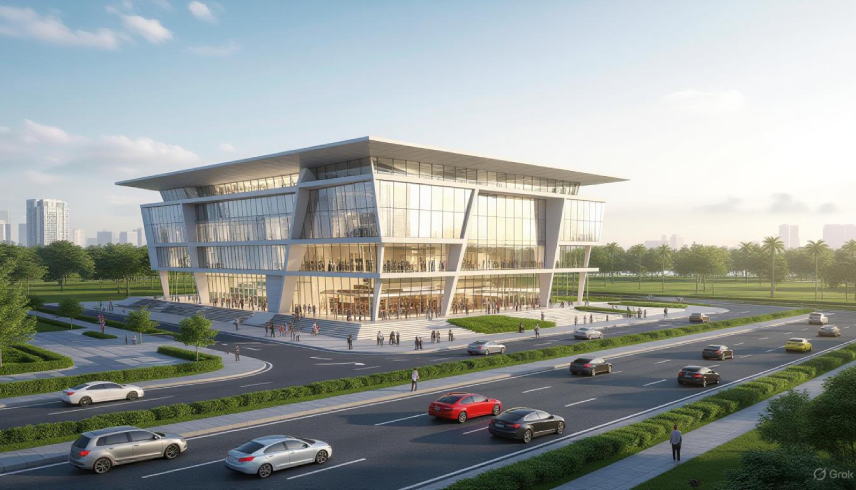
- Planned industrial smart city with phased development under government supervision.
- Activation Area (~22.5 km²) is the first operational zone with trunk infrastructure ready.
- Strategically positioned between Ahmedabad and the Gujarat coastline, enabling industrial-logistics integration.
- Entire region is still under development, with limited current population density.
Connectivity & Transport
- Ahmedabad–Dholera Expressway (109 km, operational Feb 2026) reduces travel time to ~45 minutes.
- Dholera International Airport (~15–20 km) under construction, expected to drive cargo and passenger traffic.
- Planned Ahmedabad–Dholera semi-high-speed rail as part of DMIC corridor.
- Bhimnath–Dholera freight rail line approved to connect with Dedicated Freight Corridor.
- Existing NH-47/NH-48 connectivity improved through expressway integration.
- The expressway significantly enhances accessibility and reduces logistical friction for industries.
- Airport and freight rail will position Dholera as a logistics hub once operational.
Educational Institutions
- Integrated school planned within Activation Area (CBSE/ICSE/IB curriculum).
- Proposed 40-hectare university campus in master plan.
- Currently, no major schools or colleges within 5 km radius.
- Nearest established institutions are in Ahmedabad (~100 km away).
- Early-stage social infrastructure may impact immediate residential livability.
- Long-term education ecosystem is planned but not yet operational.
Healthcare Facilities
- Multi-specialty hospital (100 beds, expandable to 200 beds) under development.
- Basic primary health centres available in surrounding villages.
- Additional hospitals planned as population increases.
- Healthcare infrastructure is currently limited but aligned with phased population growth.
- Emergency and advanced care will depend on Ahmedabad in early phases.
Commercial & Retail Zones
- ABCD Building acts as centralized administrative and business hub.
- Organized food court (7,467 m²) planned for workforce and visitors.
- Proposed 5-star hotel (Greentech/Tata Hotel) ~5 km from core area.
- Local retail clusters planned within residential townships.
- Commercial ecosystem is in early stages, primarily serving industrial workforce.
- Retail depth will expand as residential density increases.
Leisure & Public Spaces
- 6 km Dholera Riverfront planned with promenades and public spaces.
- 100-hectare City Park designed as central green zone.
- International Tent City planned for business tourism and events.
- Sports complexes and recreational zones proposed.
- Strong focus on planned urban lifestyle infrastructure.
- Execution timelines will determine usability in near term.
Government Projects & Infrastructure
- Ahmedabad–Dholera Expressway completed, enhancing regional connectivity.
- Dholera International Airport under development with cargo focus.
- Tata Electronics semiconductor fab (₹91,000 Cr investment) under construction.
- Dholera Solar Park (5 GW capacity) among world’s largest renewable projects.
- Activation Area fully developed with roads, drainage, power, and ICT systems.
- Smart city backbone includes CIOC control center and 400 kV substation.
- Government-led infrastructure is the primary growth driver.
- Large-scale capital investments improve long-term economic viability.
Private Developments
- Fidato Luxuria – plotted residential development, ready-to-move inventory.
- Aamani SIR – large-scale plotted development (~330 units).
- 7 Ocean Greens – plotted community across ~9 acres.
- Additional mixed-use township planned (~1,500 apartments with retail).
- Majority of projects are plotted developments, targeting early investors.
- Limited high-density residential or rental-ready inventory currently.
Environmental Conditions
- Planned green infrastructure includes riverfront and large parks.
- Water supply to be sourced from Narmada canal system (~950 MLD planned).
- Integrated drainage system with canal-based stormwater management.
- Low current pollution levels due to limited industrial activity.
- Environmental planning is strong on paper with sustainable infrastructure.
- Industrial expansion may increase pollution, requiring regulatory control.
Economic Activity
- Semiconductor manufacturing hub led by Tata Electronics (20,000 jobs expected).
- Renewable energy ecosystem driven by 5 GW solar park.
- Logistics expansion by global firms like NX Logistics and Nippon Express.
- Proposed IT/ITES parks and electronics manufacturing clusters.
- Increasing investor interest due to infrastructure and policy push.
- Industrial demand is the primary trigger for land appreciation.
- Employment generation will gradually support residential demand.
Real Estate Impact Summary
Positives (Investment Drivers)
- Infrastructure-led growth with expressway, airport, and rail connectivity improving accessibility.
- Strong government backing and inclusion in DMIC ensures policy continuity.
- Presence of anchor investments like semiconductor fab and solar park boosts long-term demand.
- Availability of large land parcels at early-stage pricing allows entry at lower cost basis.
- Planned smart city infrastructure reduces future redevelopment risk.
Limitations (Investment Considerations)
- Current livability is limited due to lack of operational social infrastructure (schools, hospitals, retail).
- Real estate demand is largely speculative and dependent on future execution timelines.
- Rental yield potential is low in the near term due to limited population.
- Heavy reliance on government project execution; delays can impact appreciation cycles.
- Majority of supply is plotted development, which may require longer holding periods for returns.
Overall, Dholera SIR represents a long-term infrastructure-driven investment opportunity where value appreciation is closely tied to execution of industrial and connectivity projects rather than immediate end-use demand.